

Pinan, a Shuri-te legacy
In many modern styles of karate, like Shotokan, Wado Ryu, Shito Ryu, it is customary for the new student to start with the 5 Pinan or Heian kata before tackling the more advanced kata. Pinan being the original Okinawan name, Heian the Japanese reading of the same kanji. In Shotokan and its derived styles, the first kata to start with is the original Pinan nidan (Heian shodan), because it is easier than the original Pinan shodan (Heian nidan). For many practitioners, Pinan or Heian is connected to ‘basic’. These are the basic forms for beginners. And once learned, when we start with more advanced kata such as Kusanku (Kanku dai) or Passai (Bassai dai), we want to forget about them as fast as possible.
Channan vs Pinan
It is widely accepted that Anko Itosu (1831 – 1915) was the creator of the 5 Pinan kata. The creation of Pinan shodan and nidan must have been around 1880 already and the 3 other ones probably much later when Itosu started to use them as teaching material in Okinawan schools in the early 1900’s. When Choki Motobu (1870 – 1944) was around 12 years old, he studied Channan with Anko Itosu. When later in life Motobu saw a student of Itosu performing Pinan kata, he recognized it as Channan. Which led to the belief that Channan is an original kata from China, brought to Okinawa by Bushi Matsumura after one of his China travels. Itosu confirmed to Choki Motobu that indeed this was the same kata as Channan, with some minor changes, but that he had changed the name to Pinan as his students preferred that name. Which means most probably that the original name of Pinan shodan and nidan was Channan dai and Channan sho. There is an alternative belief that it was Bushi Matsumura himself who created the Channan kata, and that Itosu continued that work by adding 3 more kata to the list, when he started to teach karate in Okinawan schools, which consisted of 5 years. For every year, another kata was needed.
In my article ‘The History of Shuri-te kata’, I connected the Fuzhou 5-ancestor Battle form ‘Pingma Zhan’ (平马战) to Naihanchi. ‘Ping’ (平) in Pingma, means level – even – flat – calm – peaceful. It is the same word as ‘pin’ in Pin-an or in Japanese it is read as ‘hei’ as in Hei-an. Bushi Matsumura brought Pingma Zhan (Level Horse Battle) back to Okinawa, where it became Naihanchi (Battle in Horse Stance). Naming convention on Okinawa was not a strict process before karate made its way to Japan. Ronald L. Lindsey writes in his book “Okinawa no Bushi no Te” that the terms Pinan (平安) and Channan (長安) have practically the same meaning.
The five Pinan kata
I presume there have been very detailed indebt analysis’s made already on the 5 Pinan kata, which is not the purpose of this article, so I will give just a brief overview of each kata. The pattern of all 5 Pinans is very similar and visibly based on the pattern of Kusanku.
Pinan shodan starts with a technique that you can find in many versions of the Chinto kata. But if you look at the whole sequence of the 3 movements to the left, repeated to the right, you find this same sequence also in Kusanku. Mostly executed in a deeper stance, sometimes starting with a Manji block or something closer to the opening technique of Pinan shodan. In Kusanku those 2 sequences of 3 techniques are split by a mae geri followed by jodan uchi-shuto-uke, these 2 techniques became part of Pinan yondan. After these sequences to the left and to the right in Pinan shodan, we continue with a kick to the back, followed by the 3 shuto’s going forward and the Nukite. This whole sequence comes straight from Kusanku. The following sequence of 4 shuto’s are also found in Kusanku. We continue Pinan shodan with sequences of punch-block divided by mae geri. The punch block combination comes from the opening sequence in Kusanku, right after the shuto’s, left and right. Itosu shows that you can recreate new kata, by changing some sequences of techniques. In the beginning of Pinan shodan for example, he takes away the mae geri’s and in the last described sequence, he adds mae geri’s. The whole kata described up to now comes directly from Kusanku, which makes the theory that the Channan/Pinan kata was an original kata hard to maintain. And we end with 2 basic block techniques, gedan barai and age uke. This last technique is a bit of a mystery, in the shuri-te kata, you only find a stand-alone age uke in Pinan shodan and nidan. It is nowhere to be found in the older kata as a stand-alone technique. A second observation is that in multiple Shuri-te styles, there is no yoko geri in kata, only mae geri, either to the front, or in the opening of Pinan shodan and Kusanku, it is a mae geri to the side. Kicks were gradually changed under influence of sports karate. Sports karate had a more spectacular character than the original idea of self-defense. In self-defense, you don’t want to put your body out of balance or turned away from the attacker. During one of his zoom classes, Hanshi Peter Polander explained that in self-defense karate, kicks are used together with arm movements, not one after the other. The purpose of kicks is not to end a fight, kicks are used as Atemi strikes, to deliver pain, and to unbalance the opponent. You want to keep both arms in immediate range of your opponent, so you would only kick below the belt, without turning your body away. Atemi kicks are done on the inside and outside of the thigh, behind the knee and to nerve points on both sides of the shin. The kata seems to agree with that concept, whenever there’s a kick in kata, it is together with an arm movement, not as a separate technique.
Pinan nidan, the second kata, is much more basic than the first one. Except for the hammer fist(s) at the opening, similar movement to be found in Useishi (Gojushiho) as a downward Uraken, all the movements are basic kihon practice; gedan barai, age uke, junzuki, until the last sequence that is a bit out of place. In Shotokan those last movements are shuto-uke’s, just like in Pinan shodan or Kusanku. In Okinawan styles they are low nukite’s or blocks with open hands, like in some Shorin Ryu versions of Passai or similar to movements in Kusanku, Chinto and Useishi (Gojushiho). But curiously also very similar to Bushi Matsumura’s Hakutsuru.
Pinan sandan, the first of the last 3 Pinan kata, starts with a combination of Uchi uke followed by double blocks. A sequence from Naihanchi shodan. After that, the spear hand and turn like in Kusanku, followed by 1 or 3 junzuki’s, depending on the style. The turn, with the following sequence of 3 elbow blocks, comes from Chinto. The last movements to both sides can be seen as a variation on holding both fists one on top of the other that you find in Chinto or Naihanchi shodan.
Pinan yondan has a similar opening as Pinan shodan, but with open hands. Most of the techniques come from Kusanku with some techniques from Gojushiho and Chinto.
Pinan godan is the shortest of the five, you will find most of the techniques within this form in Chinto.
Pinan is not the only attempt made to break down longer more complex kata in shorter versions for teaching purposes. Another example is the kata Jion. From Pinan, it is a natural step to continue with Jion, one of the 3 ‘temple’ kata’s, the other two being Ji’in and Jitte. The two latter having a history that we can trace back to before the 1900’s, which is not the case for Jion. If we look at this kata, we can see a close resemblance to the other two mentioned, Jitte and Ji’in, but also to Useishi (Gojushiho). Jion looks like a simplified version of this older form, with techniques from Jitte, Ji’in and Naihanchi shodan (middle section and end) included. The creator of Jion is not known, it was taught by the circle around Itosu Sensei, who could be the creator, but some sources declare the creator to be Yabu Kentsu.
Pinan legacy
Knowing now that there are no original techniques in the Pinan kata, that all techniques are taken from the old kata passed on by Sokon Bushi Matsumura, the vast majority from Kusanku, Chinto and Useishi (Gojushiho). Knowing that the Pinan kata were intentionally created for school children as part of physical education. Why would we still practice them? We are training karate on a different level than school going children. Fact remains that it is easier to learn Pinan shodan (Heian nidan) than to start with Kusanku. But once we go through the Pinan’s and we start with the old kata like Kusanku, why would we continue to practice Pinan? One reason could be that the mentioned old kata that were the sources for Pinan are not all practiced in all systems. If you don’t have Chinto kata in your curriculum, it makes sense to study Pinan sandan, yondan and godan, because some karate techniques you can find only in Chinto or in those Pinan kata.
It is said that Itosu sensei created Pinan and left out the more dangerous techniques that were in the old kata. But when you compare the techniques in the old kata to the techniques in Pinan, they are exactly the same. Where are those dangerous techniques from Kusanku that you don’t find in Pinan? It is not the dangerous techniques that disappeared, what disappeared is the knowledge on what those techniques really mean, what the real applications are. There is lots of material now on Youtube from seminars with the late Taika Seiyu Oyata (1928-2012) where you can discover a wealth of real Okinawan warrior class kata applications. Or you can feel the brutal effectiveness of those techniques firsthand in one of the dojo’s or seminars of Hanshi Peter Polander.
And in case you do have all the old kata in your system that stood as model for Pinan, you could argue if it still makes sense to practice Pinan. It’s a question I am struggling with myself. Today the Pinan kata are well over a century old. Pinan is the door that opened the secret style of Okinawan fighting to the rest of the world. First via the school system on Okinawa, from there to Japan and to the rest of the world. It is part of the legacy of the man who gave Okinawan Karate to the rest of the world. Anko Itosu is the composer of these 5 master pieces, and they are a very important part of our Shuri-te legacy. All the dangerous Okinawan self-protection techniques are there, but you need a true master to show them to you. A true master will show the Tuite techniques that are hidden in these kata at the very beginning of your karate path. When a master tells you there are secret dangerous techniques hidden in the kata, but after 10, 15, 25 years of training still doesn’t show those, I seriously doubt that kind of ‘Mastery’. It’s not by showing a dangerous Tuite or Kyusho technique that somebody will be able to use that in practice. There is no magic wand in Karate. There is only hard practice and deep understanding. The Art of Tuite takes many years more to master than punching and kicking, so the earlier you start with that training, the better. Pinan is an immense catalogue of Okinawan self-defense techniques. No different than Kusanku, Naihanchi, Passai or Seisan. For many of us, it was our first contact with the Art of Karate, it is good to cherish these forms and get even deeper understanding of their content and applications.
Dagmar Uythethofken
Shiro Washi Ryu Kempo
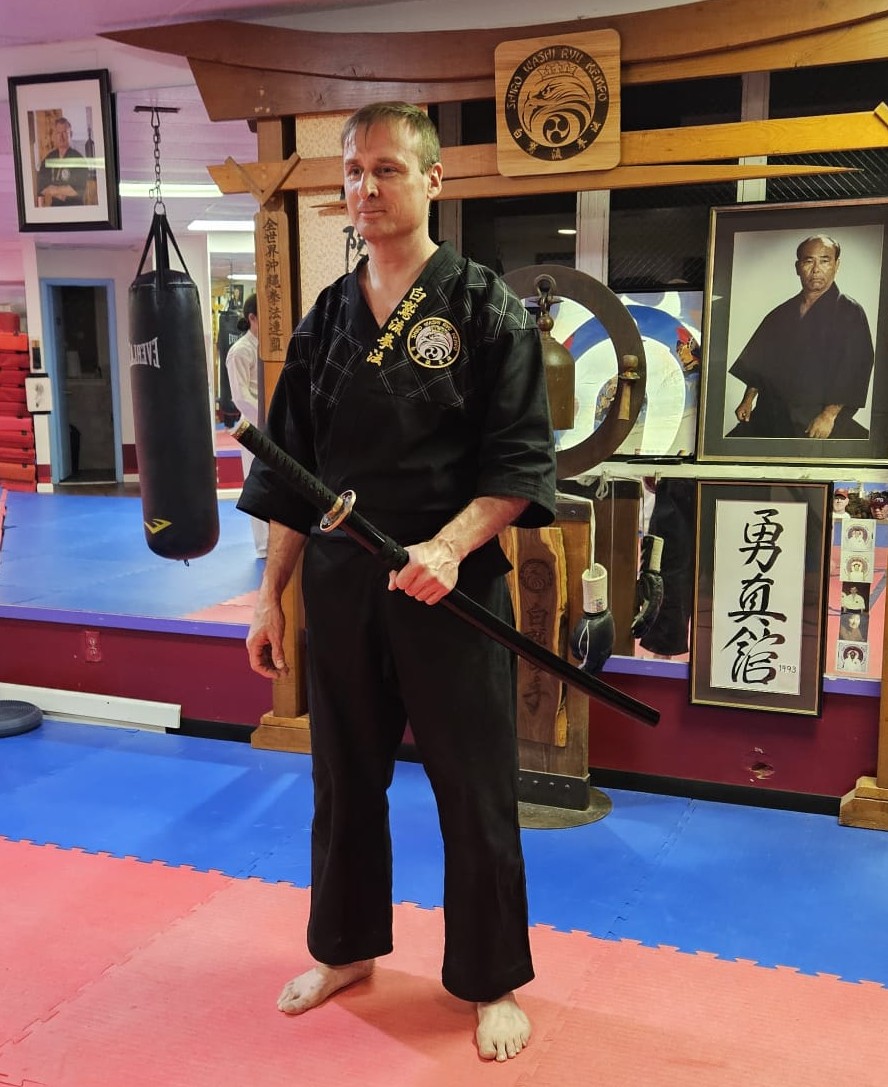
Sensei Dagmar Uythethofken (3 Dan)
Dagmar Uythethofken, born in Brussels, Belgium on the 12th of March 1976, started his martial arts path in 1985 with Judo and later Jujitsu. When he moved cities, he could finally practice the art he was most interested in, Karate. After practicing Wado Ryu karate for 5 years, he was forced to stop martial arts for a while to pursue a professional career as a classical pianist. After studies there were periods of training Wado Ryu and YMAA White crane-Long Fist kung fu till he moved abroad to Krakow with his family, where he started practising Okinawan Kempo in 2014 under Sensei Norbert Andrzejewski. He continues his study under Hanshi Peter Polander. In 2026, after participating in the international Hands of Okinawa Seminar in Delaware, USA, he was invited to provide training at the Shiro Washi Ryu Kempo headquarters, the Polander Academy of Martial Arts in Bethesda, USA. Since 2025, he's teaching Shiro Washi Ryu Kempo in Park Lotnikow in Krakow, Poland.