

The art in Martial Arts
If we think about Art, we think about objects like paintings or sculptures. Objects we can hang at the wall and admire when we want to. A less tangible sort of art is music, although there is a written score, the art is appreciated when listening to that music. Just like dance, it needs to be (re-)created on the spot. We use the term Martial Arts to define our practice. But what exactly does the ‘art’ part refer to? Can you witness it in the dojo or in a kata competition? For sure you can call a superb kata performance artful, just like a dancing performance. But is it Martial Art?
If you ask a hundred people to name a nation connected to martial arts, Japan would be on number one. And with good reason, there's no other nation that breaths martial art like Japan did during its history. Miyamoto Musashi is one of the highest expressions of True Martial Art. If you read Musashi, you understand that Martial Art is about the living fighting spirit and not about the form, like music is not about the written score.
The end of the Tokugawa Shogunate had tremendous influence on that spirit of Martial Arts, the spirit of fighting arts. With the Meiji restoration (1868) and the abolition of the samurai class (1869), more and more focus was put on the form of the martial arts instead of on the spirit and real knowledge of life and death battle.
The change was the same on Okinawa. When the Ryukyu kingdom was annexed by Japan in 1879, and the Ryukyu Bushi class lost its purpose of existence, the martial ability was no longer a profession, but became a discipline practiced by laymen. The Bushi class on Ryukyu had always kept their true fighting arts very secret, that didn’t change now some of them started teaching people outside of their class. Their art died out almost completely. Laymen who became interested received only the form of the Ryukyu arts or travelled to China to bring Chinese methods back to Okinawa.
When karate was presented to Japan by these laymen, it was only the form that was presented, not the true fighting art. The Japanese perfected this form. All focus was put on the perfect stance, the perfect arm positions, cataloging and naming every movement, where before on Okinawa there was no naming convention. Everybody's technique should look exactly the same, where before the very individual posture and way of moving was taken into consideration. This focus on form culminated into two Japanese sport disciplines, kata and kumite. That perfection of form goes to the extreme if you look at the sport discipline of group kata, three participants performing the same kata, in perfect synchrony. Very pleasing and spectacular to the eye, but you cannot call it martial arts, it is a moving discipline, very much like gymnastics, but with karate movements. Hundred percent of the effort is being put into this outer performance. There is no real knowledge of actual self-defense. This is very much shown in the way bunkai are performed after the kata performance. Applications from within the kata, performed with an attacker and defender. The bunkai becomes a choreography based on these outer movements of the form. Somebody who has never practiced karate could make such choreography by just looking at those outer movements. The focus on perfect form is very important when you start your journey in self-defense, and it takes many years to refine this form and you’re never really done with that work. But you can't stay at that level, self-defense goes beyond that. True artistry goes far beyond form.
Great artists are rare. During the last decade, I’ve had the honor of being close to such a rare true artist of Martial Arts, and on occasion to receive face to face instruction, the way the Art was taught in the old days. Hanshi Peter Polander, a senior student of the late Taika Seiyu Oyata (1928 – 2012) has taken the true Spirit and Art of Taika and is keeping it alive and continuing it. Standing right in front of a true artist when he is performing his art has a tremendous impact. My last encounter with Hanshi Peter Polander transcended my vision on Martial arts. A path I started 40 years ago. It is a unique experience to be so close to true Martial Art. Hanshi Polander showed me parts of different kata and their true application, and although I know those kata movements very well, they were as from a different planet. I couldn't tell you exactly in which stance Hanshi Polander was standing, it was a stance that was ready to destroy me. The arm movements were not this particular technique or that one, they were pure martial movement, movement which would destroy the adversary in a blink of an eye. Astonishing beautiful in its brutal effectiveness. I realized that at that level, the art can't be defined in form anymore, it becomes true living martial art. Witnessing such performance of true art is a life-changing experience, maybe close to a concept called ‘direct transmission’ in Zen Buddhism, an understanding that is passed directly from mind to mind. That can only happen with the uniqueness of face-to-face transmission.
Practicing any martial art has great benefits for the practitioner. The true art of self-defense, perfected a long time ago by the warrior class, who’s life purpose was to keep it alive and refine it, is another thing completely. Exercising your outer performance of a form to receive a gold medal gives purpose. Understanding the true inner content of that form is transcendental.
There is no other way to start your martial art journey than to go through learning correct stances, blocks, punches. Perfect form is expected from a black belt, but that really is only the beginning of the path. Now you know how to hold your pencil, how to draw forms, use different colors, but painting a piece of art has not much to do with these basics. Great artists are very few. And how could they possibly explain what they are doing exactly. That is something that needs to be lived through. Hanshi Peter Polander once told me, “A teacher gives you 1/3, if the art means more to you than life, God will give you the rest”. A Master can guide you up to a certain point, but to go beyond, you have to make this path your life, breathe it, live it. Holding on to what we know and what can be explained to us is very comfortable. Becoming a martial artist is a lonely path. If you don’t give air and wood to the fire every day, it will get smaller or go out.
Dagmar Uythethofken
Shiro Washi Ryu Kempo
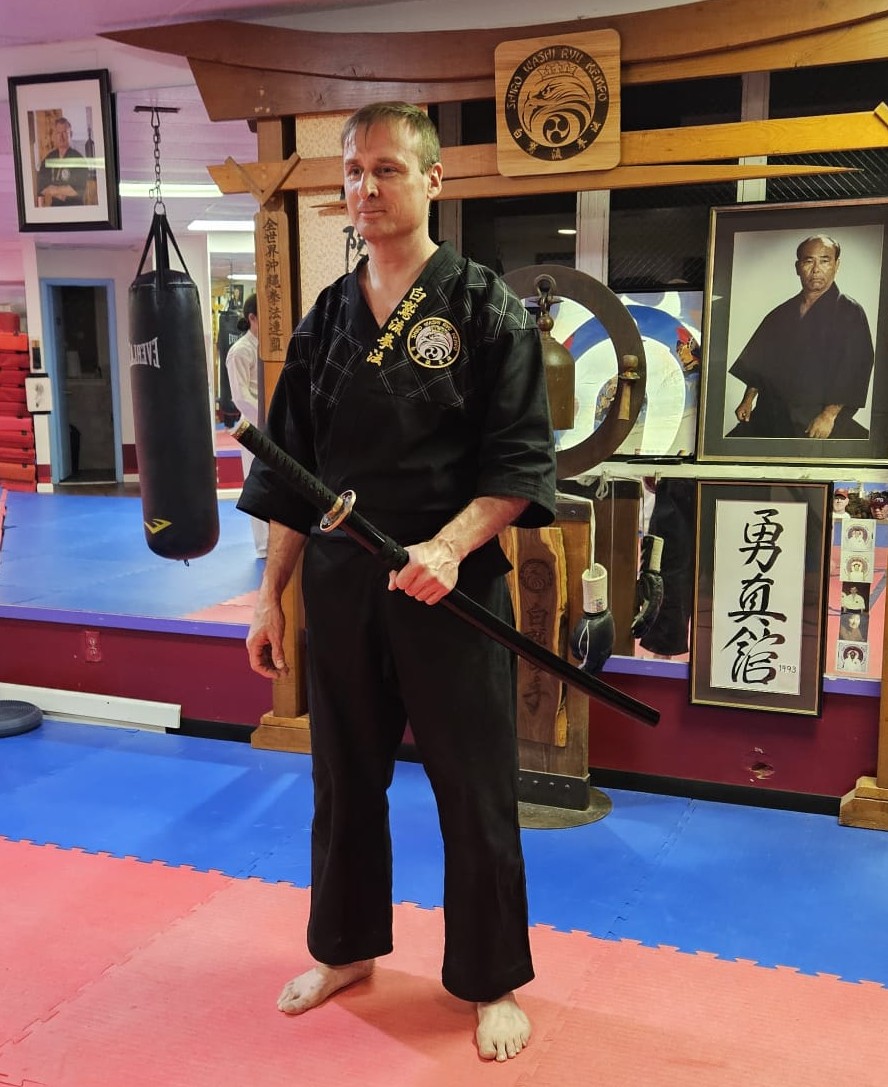
Sensei Dagmar Uythethofken (3 Dan)
Dagmar Uythethofken, born in Brussels, Belgium on the 12th of March 1976, started his martial arts path in 1985 with Judo and later Jujitsu. When he moved cities, he could finally practice the art he was most interested in, Karate. After practicing Wado Ryu karate for 5 years, he was forced to stop martial arts for a while to pursue a professional career as a classical pianist. After studies there were periods of training Wado Ryu and YMAA White crane-Long Fist kung fu till he moved abroad to Krakow with his family, where he started practising Okinawan Kempo in 2014 under Sensei Norbert Andrzejewski. He continues his study under Hanshi Peter Polander. In 2026, after participating in the international Hands of Okinawa Seminar in Delaware, USA, he was invited to provide training at the Shiro Washi Ryu Kempo headquarters, the Polander Academy of Martial Arts in Bethesda, USA. Since 2025, he's teaching Shiro Washi Ryu Kempo in Park Lotnikow in Krakow, Poland.