

Karate Do vs Karate Jitsu
Karate Do
During the Tokugawa Shogunate, which marked the end of a long period of civil war in Japan, a change took place in the martial arts of that time, a shift from Bujitsu to Budo. A shift in the philosophy of martial art from focusing on killing the enemy to becoming a better moral person through hard training. Karate Jitsu, the Art of the Okinawan warrior class, almost died out with the end of the Ryukyu Kingdom (1879), when it was annexed by Japan. Instead, Karate Do came to life, a style practiced outside of the warrior clans.
Karate Do is a path to self-development. The focus is on absolute perfection of posture, movement, timing, and concentration. Martial arts practice is often inseparable from certain spiritual practices. There is a strong connection between the Eastern martial arts and practices like Taoism, Shintoism or Buddhism. The goal of those spiritual practices is self-realization or becoming one with the universe or creator. You can find this search to become one with the creator also in the Western practices of Christian mysticism. Reaching the highest unity with God is a main theme of for example my countryman Jan van Ruysbroeck (1293 – 1381). If we go back to the East and talk about martial art and spiritual practice, we immediately think of the Shaolin monastery and the illustrious creator of Shaolin kung fu, Bodhidharma. He was the first patriarch of Zen Buddhism on Chinese ground. From Zen Buddhists we know that they spend daily hours in sitting meditation. Something comparable to the practice of ‘Mokuso’ that is performed before and after training in many dojo’s. But the arts of Zen are not confined to sitting meditation. We have moving Zen arts like the art of archery, calligraphy, the tea ceremony, flower arranging and other martial arts. It is easier to see the Zen aspect of the martial art of archery, Kyudo, than to see it in Karate. Unless we look at kata, which is like the art of Kyudo a pre-arranged form that we repeat over and over again. When in Zen meditation you put all your will power and awareness into your mind and thought process, in that way trying to stop the flow of uncontrolled thoughts, in the moving Zen arts, you put all your mind and awareness into will processes, the movements of your body. The ultimate goal for the Do practitioner, as a result of daily practice of the same movements with complete awareness, is to become one with the movement. In Karate Do, there is hardly any relation between kata and kumite practice. They are two completely different disciplines. Nobody fights kumite in the way they perform kata.
Karate Jitsu
Karate Jitsu is a term that is popping up more and more, just like Koryu styles, meaning ‘old’ styles. The truth is that there are extremely few Karate schools which practice the Art of the Okinawan warrior class from before of the end of the Kingdom of Ryukyu. The Art of the Okinawan warrior class consisted of armed (Kobudo) and unarmed (Tuite) fighting techniques. The one going hand in hand with the other. One of the more famous Okinawan warrior clans was the Uhugushku clan. Going back to ‘Uni’ Uhugushku (begin 1400 – 1469). The clan was responsible for guarding the gates and the sleeping quarters of the royal family at the Shuri castle. The last active warrior descendant of that centuries old Okinawan clan passed his art of Kobudo and Tuite to the late Taika Seiyu Oyata (1928 – 2012).
Tuite techniques, just like Kobudo techniques, were trained with a partner within the warrior clan. We don’t know when the practice of kata started on Okinawa, sources are not going back more than a few hundred years, since around the beginning of the 18th century. In Karate Jitsu, kata is a storage system, a catalogue of different techniques, passed on to the next generations. It is also a tool to perfect the movements of body, feet, arms and hands to be able to perform Tuite on an aggressive attacker, if you know how. This practical knowledge is mostly gone. Modern Karate, Karate Do, consists of only the basic, obvious visible techniques in kata, meaning punch, kick, block.
In Karate Jitsu the movements of the same kata practiced in Karate Do, are very different. Where in Karate Do there is only knowledge on how the movement ends, for example a Shuto-Uke followed by a Nukite, in Karate Jitsu there is knowledge on what happens between those movements, and that knowledge will make the technique work.
Hanshi Peter Polander is making the hidden code of the kata public. It is a very complex code, and it takes many years of dedicated practice under a Jitsu master to understand it. The Karate Jitsu practitioner learns that the movements that follow each other in kata are like the letters of the alphabet. By combining different letters, you make new words. By combining separate techniques from the kata or from different kata, you practice self-defense. The Karate Jitsu practitioner will break down the kata in separate techniques and combines those techniques to practice different applications with a partner. Separate movements can be practiced with multiple repetitions. But by training the kata as a whole, one trains the correct body mechanics, which result in lightning-fast reflexes and automatic responses of the body. In Karate Jitsu, kata practice is the basis of self-defense in an actual fight. Where in Karate Do, movements practiced in kata are not very practical in an actual fight.
Bad Uke
Your training partner, the one that attacks you, giving you the opportunity to practice your defense techniques, is called Uke. The different ‘Do’ styles make use of bad uke's. If you look at an Aiki-do demonstration, uke, the attacker, is moving forward merely extending his arm. Far from a real-life attack in a bar fight. And once contact is made, the attacker doesn't resist the counter, but on the contrary helps the defender and works with the defender to perform his defending technique, resulting in a spectacular looking role over the ground for example. Quite the same with most Karate Do demonstrations. The attacker starts his attack by stepping forward in zenkutsu dachi and uses a junzuki punch for example, very often not with realistic distancing. Once he finishes his attack, he will remain in that stance with his arm stretched out, leaving time for the defender to complete his defense technique.
Of course for a beginner, there needs to be time to learn defense techniques in a slower, more static way. But quite quickly, the attack needs to happen in a more realistic way. No more zenkutsu dachi and junzuki or gyakuzuki, but proper fast powerful boxing combinations with retrieving the arm immediately.
Karate Do relates to Karate Jitsu as the art of calligraphy relates to writing a letter. The art of calligraphy practices, polishes, perfects the same movement daily for years in a row using a specific position, technique and state of mind. Writing a letter this way would be very impractical. To write a letter you need a different technique, but also different knowledge, you need to learn proper grammar, understand different writing styles, etc.
At one of our Okinawan Kempo seminars, which are open to everybody, I remember an Aikido master joining for the first time. I was training with him, when Hanshi Peter Polander came over and politely asked the Aikido 5th dan black belt to perform a wrist lock on him. A wrist lock being a basic Aikido technique. Our guest gave it his best shot, but the technique didn't work on Hanshi Polander. I first saw the amazed and embarrassed expression on that Aikido master's face when he realized his technique didn't work, but half a second later he had his mouth wide open in utterness unbelief, when he lay on the floor. I know now that Hanshi Polander did a counter technique on him that reverses the wrist lock, but I didn't see at all what happened, it happened too fast. That's the difference between Do and Jitsu. A Do practitioner (Aikido, Karate Do, ...) can polish a technique for many years, but the result is not always practical. A Jitsu practitioner has to have different knowledge. Extreme understanding of the mechanics of your own body to be the most effective possible in performing a technique, but also of the opponent's body, to know where the weaknesses are, from which angle to perform a technique, how to destroy his balance, with 100% effectiveness on an opponent that is resisting and trying to hurt you. It must have been hard on the 5th dan Aikido master, who had trained that art for decades, to be confronted with reality. If you train all those years defending against unrealistic 'attacks', with bad Uke's, it takes only half a second to realize all those years of practice were a fata morgana, not effective at all. Not many people can cope with that. In the case of this Aikido master, initially he started learning Okinawan Kempo, but after a while he went back to what he knew, and we didn't see him again. Which is an understandable human reaction. We had other examples as well, but those are more exceptional. Karate masters from different styles, professionals with sometimes decades of experience, who come to our seminars and see the difference between the Do they were practicing and the Jitsu they experience now. It takes an extremely strong personality and brutal honesty, sincerity, and dedication to something more than oneself to take that step.
Unless the calligrapher learns other skills, he will not be able to write interesting books. Same for the Do practitioner. To become an efficient fighter, more is needed than the normal kata and kumite practice.
Do or Jitsu?
Now the question will arise, what should I train, Karate Jitsu or Karate Do? The art of the warrior clans from Okinawa is a very complex art, which takes many more years of dedication. Dojo’s that train this art are extremely rare. If you see partner applications with high kicks, chambered punches, retrieving the arm before blocking, the use of stances like zenkutsu dachi, neko ashi dachi or any of the dachi’s, it is not Karate Jitsu. Any kind of competition has nothing to do with Karate Jitsu.
In our world, the lessons Karate Do teach to discipline body and mind are maybe more important than being able to fight for your life. We already discussed that performing kata on a daily basis is a moving Zen discipline. Reinforcing our will, which is the result of this practice, is invaluable for the modern human being in dealing with the everyday problems of stress, nervousness, undecidedness, or purposelessness to name a few. Karate Do is a beautiful Art that equips you with a mindset that prepares you to deal with life in a very unique way.
On the other hand, the preservation and continuation of the fighting Arts that were developed and perfected over the centuries by the Okinawan warrior clans, is the duty of everyone who has had the privilege to receive this knowledge. On Okinawa, it was not for the big masses, but for the few. For the rest of the world, it is the same principle.
If you are interested in seeing some kata Jitsu applications, please visit our Youtube channel www.youtube.com/@okinawankempokarate
Dagmar Uythethofken
Shiro Washi Ryu Kempo
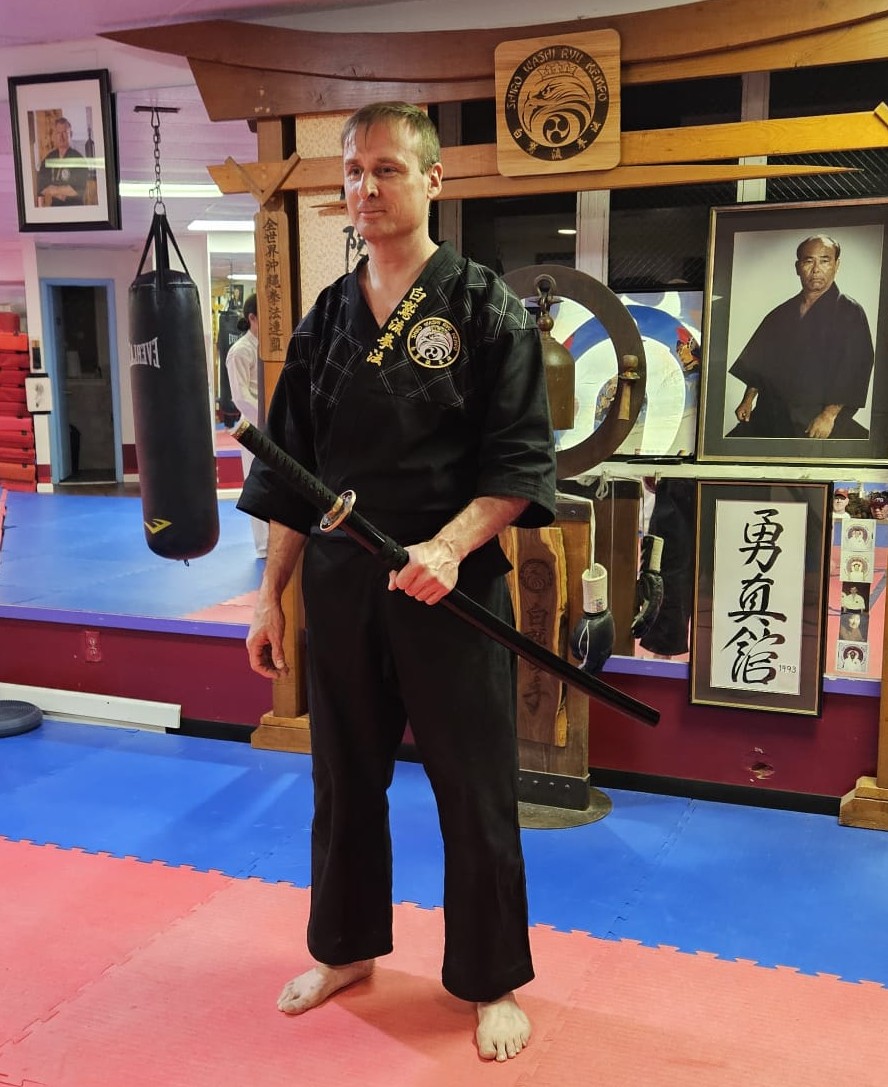
Sensei Dagmar Uythethofken (3 Dan)
Dagmar Uythethofken, born in Brussels, Belgium on the 12th of March 1976, started his martial arts path in 1985 with Judo and later Jujitsu. When he moved cities, he could finally practice the art he was most interested in, Karate. After practicing Wado Ryu karate for 5 years, he was forced to stop martial arts for a while to pursue a professional career as a classical pianist. After studies there were periods of training Wado Ryu and YMAA White crane-Long Fist kung fu till he moved abroad to Krakow with his family, where he started practising Okinawan Kempo in 2014 under Sensei Norbert Andrzejewski. He continues his study under Hanshi Peter Polander. In 2026, after participating in the international Hands of Okinawa Seminar in Delaware, USA, he was invited to provide training at the Shiro Washi Ryu Kempo headquarters, the Polander Academy of Martial Arts in Bethesda, USA. Since 2025, he's teaching Shiro Washi Ryu Kempo in Park Lotnikow in Krakow, Poland.